RHETORICAL INTELLIGENCE
Law as Narrative, Persuasion, and Human Drama

LESSON 3
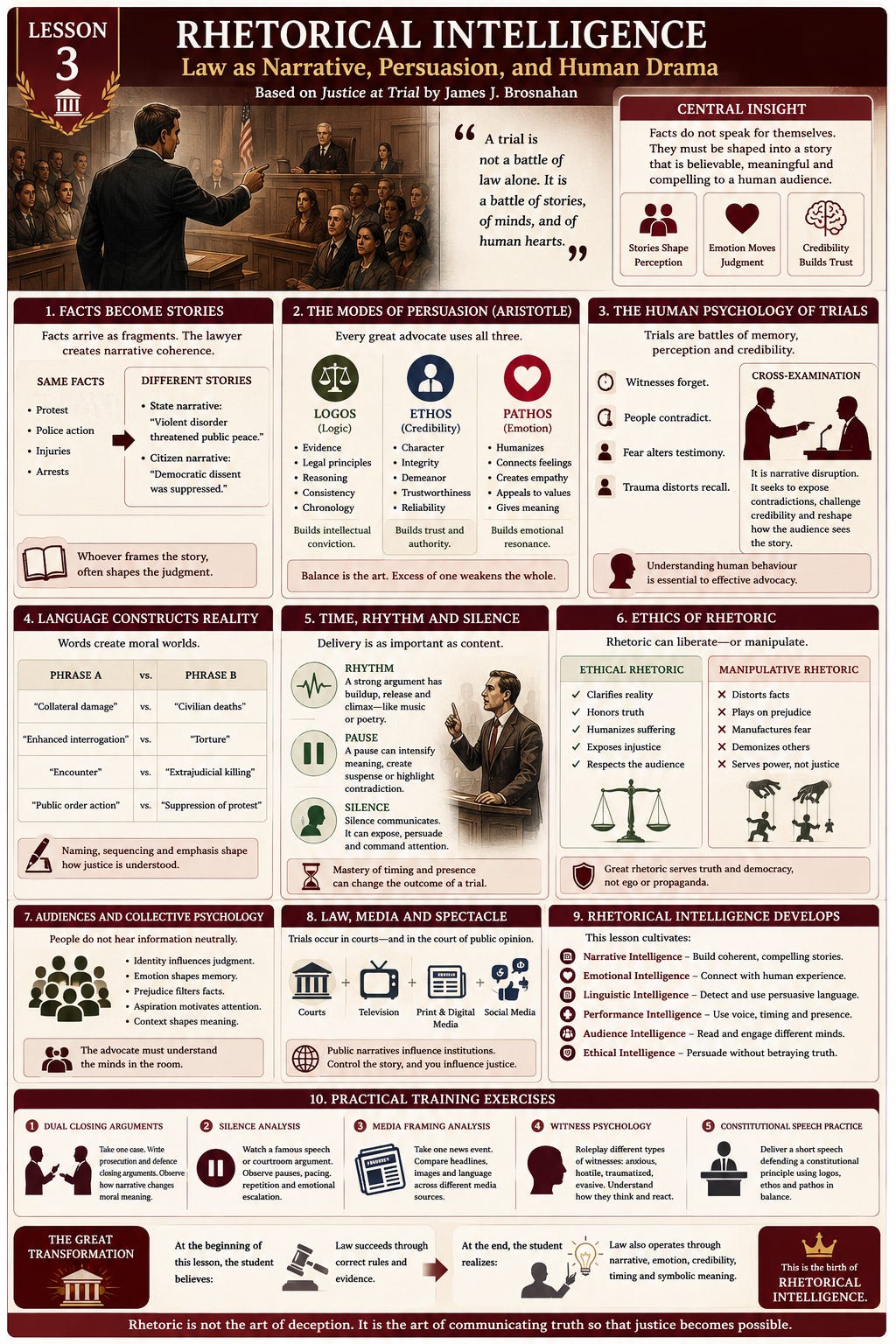
RHETORICAL INTELLIGENCE
Law as Narrative, Persuasion, and Human Drama
Based on
Justice at Trial
Opening Orientation
In Lesson 1, we learned:
Law is not mechanically neutral.
In Lesson 2, we learned:
Rights are meaningless without access and institutional morality.
Now we enter the next great transformation.
Even when:
rights exist,
courts are accessible,
and institutions function,
another question emerges:
How does persuasion shape justice?
This is the beginning of:
RHETORICAL INTELLIGENCE
What Is Rhetorical Intelligence?
Rhetorical intelligence is the ability to understand:
how narratives shape legal outcomes,
how persuasion operates institutionally,
how language creates emotional reality,
how credibility is constructed,
how audiences interpret meaning,
how courtroom performance affects judgment,
and how truth itself must often be narratively organized.
A rhetorically intelligent person understands:
Facts do not speak by themselves.
Human beings interpret facts through:
stories,
emotion,
credibility,
memory,
moral framing,
and symbolic meaning.
The Central Insight of This Lesson
Law Is Also Theatre
Not theatre in the sense of falsehood.
But theatre in the sense that:
performance matters,
voice matters,
pacing matters,
silence matters,
framing matters,
emotional sequencing matters.
A courtroom is not merely:
a technical site,
or a logical machine.
It is also:
a psychological arena,
a moral stage,
a narrative battlefield.
Why
James J. Brosnahan
Matters
Brosnahan reveals something most legal education hides.
Most law schools train:
doctrinal recall,
procedural analysis,
citation techniques.
But real litigation requires:
persuasion,
emotional intelligence,
audience reading,
strategic timing,
rhetorical architecture.
He reveals:
how trials actually feel,
how lawyers think dynamically,
how stories move institutions.
This lesson therefore shifts from:
constitutional intelligence,
toperformative intelligence.
PART I
FACTS NEVER ARRIVE AS STORIES
Facts initially exist as fragments:
dates,
documents,
witnesses,
contradictions,
memories,
objects.
The lawyer must transform fragments into:
narrative coherence.
Example
Imagine:
a protest,
a police confrontation,
injuries,
arrests.
Now observe:
Prosecutorial Narrative
“Violent disorder threatened public peace.”
Defence Narrative
“Citizens exercised democratic dissent.”
Same facts.
Different narrative worlds.
The Great Realization
Whoever frames the story often shapes institutional perception.
This is one of the deepest principles of rhetorical intelligence.
PART II
ARISTOTLE IN THE COURTROOM
Long before modern law,
Aristotle identified three modes of persuasion:
Greek Term
Meaning
Logos
Logical argument
Ethos
Credibility and character
Pathos
Emotional resonance
Every successful trial contains all three.
LOGOS
The Architecture of Reason
This includes:
evidence,
legal principles,
contradictions,
chronology,
factual consistency.
Without logos:
arguments collapse intellectually.
But logos alone rarely persuades fully.
ETHOS
The Authority of Character
Jurors and judges constantly ask:
Is this lawyer trustworthy?
Is this witness believable?
Does this speaker appear sincere?
Ethos operates silently.
Sometimes a technically strong argument fails because the advocate lacks credibility.
PATHOS
Emotional Meaning
Emotion is not opposed to reason.
Emotion organizes moral attention.
Without emotional resonance:
suffering becomes abstract,
injustice becomes invisible,
violence becomes statistical.
Pathos humanizes law.
Rhetorical Intelligence Insight
The great advocate harmonizes:
logos,
ethos,
and pathos.
Too much emotion becomes manipulation.
Too much logic becomes lifeless abstraction.
Too much performance destroys credibility.
Balance is the art.
PART III
THE COURTROOM AS HUMAN PSYCHOLOGY
A trial is also:
memory conflict,
emotional conflict,
credibility conflict.
Witnesses forget.
People contradict themselves.
Fear alters testimony.
Trauma reshapes recall.
The rhetorically intelligent advocate understands:
human behaviour,
hesitation,
silence,
nervousness,
emotional pacing.
Cross-Examination
Cross-examination is not merely questioning.
It is:
narrative disruption.
The lawyer attempts to:
destabilize certainty,
expose contradictions,
alter audience perception,
rearrange credibility.
Example
A single pause can matter.
A single repeated word can matter.
A single contradiction can reshape an entire narrative.
This is why rhetoric is inseparable from legal practice.
PART IV
LANGUAGE AS CONSTRUCTION OF REALITY
The rhetorically intelligent person learns:
Words create emotional worlds.
Consider these descriptions:
Phrase A
Phrase B
“Collateral damage”
“Civilian deaths”
“Enhanced interrogation”
“Torture”
“Encounter”
“Extrajudicial killing”
“Public order action”
“Suppression of protest”
Language frames moral interpretation.
The Legal Consequence
Courts do not merely evaluate facts.
They evaluate narrated reality.
Therefore:
naming matters,
sequencing matters,
emphasis matters.
PART V
TIME, RHYTHM, AND SILENCE
Most students think persuasion depends mainly on content.
Brosnahan reveals:
delivery matters profoundly.
Rhythm
A strong argument has rhythm:
buildup,
release,
emphasis,
pause,
climax.
This resembles:
music,
theatre,
poetry.
Silence
Silence can:
intensify meaning,
create suspense,
expose contradiction,
produce emotional gravity.
A rhetorically intelligent advocate understands:
silence itself communicates.
PART VI
THE ETHICS OF RHETORIC
Now we reach the dangerous question.
If rhetoric shapes justice,
can rhetoric manipulate truth?
Yes.
This is why rhetorical intelligence must be ethically grounded.
Ethical Rhetoric
Rhetoric becomes democratic when it:
clarifies reality,
humanizes suffering,
exposes hidden power,
communicates complexity honestly.
Manipulative Rhetoric
Rhetoric becomes dangerous when it:
manufactures fear,
distorts evidence,
demonizes communities,
exploits prejudice,
converts propaganda into persuasion.
Democratic Importance
Modern democracies are deeply rhetorical systems:
media rhetoric,
political rhetoric,
courtroom rhetoric,
digital rhetoric,
nationalist rhetoric.
Therefore rhetorical intelligence is now essential democratic survival intelligence.
PART VII
THE PSYCHOLOGY OF AUDIENCES
A rhetorically intelligent thinker studies audiences.
People rarely absorb information neutrally.
Audiences respond through:
fear,
hope,
identity,
prejudice,
memory,
aspiration,
emotional association.
Example
Two lawyers may present identical evidence.
But:
one creates emotional coherence,
the other creates confusion.
The first often persuades more effectively.
The Deeper Lesson
Persuasion is not merely information transfer.
It is:
meaning construction.
PART VIII
LAW, MEDIA, AND SPECTACLE
Modern trials increasingly occur simultaneously in:
courts,
television,
social media,
public imagination.
This creates:
spectacle justice.
Public narratives can pressure institutions.
The rhetorically intelligent student therefore studies:
media framing,
symbolic imagery,
public emotion,
reputational narratives.
PART IX
RHETORIC AND DEMOCRACY
The deepest democratic insight of this lesson:
Democracy survives partly through persuasive ethical communication.
A democratic society requires:
advocates,
teachers,
journalists,
movement leaders,
constitutional interpreters,
who can:explain complexity,
defend liberty,
humanize the marginalized,
resist propaganda,
and articulate justice publicly.
Without rhetoric,
democracy becomes vulnerable to:
demagoguery,
emotional manipulation,
authoritarian spectacle.
PEDAGOGICAL CORE OF THIS LESSON
THE INTELLIGENCE BEING DEVELOPED
RHETORICAL INTELLIGENCE
This intelligence includes:
1. Narrative Intelligence
Understanding how stories shape perception.
2. Emotional Intelligence
Understanding how feeling affects judgment.
3. Linguistic Intelligence
Detecting framing, symbolism, and persuasive language.
4. Performance Intelligence
Understanding delivery, pacing, silence, and presence.
5. Audience Intelligence
Understanding collective psychology and persuasion.
6. Ethical Intelligence
Distinguishing democratic rhetoric from manipulative rhetoric.
PRACTICAL PEDAGOGICAL EXERCISES
Exercise 1 — Dual Closing Arguments
Take one case.
Write:
prosecution closing argument,
defence closing argument.
Observe:
how narrative changes moral meaning.
Exercise 2 — Silence Analysis
Watch a famous courtroom speech or political speech.
Observe:
pauses,
pacing,
repetition,
emotional escalation.
This develops rhetorical listening.
Exercise 3 — Media Framing Analysis
Take one news event.
Compare:
headlines,
imagery,
emotional language,
sequencing.
Analyze how perception is constructed.
Exercise 4 — Witness Psychology Exercise
Roleplay:
anxious witness,
hostile witness,
traumatized witness,
evasive witness.
This develops psychological literacy.
Exercise 5 — Constitutional Speech Practice
Students deliver:
short speeches defending a constitutional principle,
while balancing:
logos,
ethos,
pathos.
This develops democratic communication.
THE GREAT TRANSFORMATION
At the beginning of this lesson, the student believes:
Law succeeds through correct rules and evidence.
At the end, the student realizes:
Law also operates through narrative, emotion, credibility, timing, and symbolic meaning.
This realization is the birth of rhetorical intelligence.
CONCLUSION
Justice at Trial teaches students that:
persuasion shapes institutions,
stories shape justice,
rhetoric shapes democracy,
and ethical communication is a civic responsibility.
The student now understands:
law as performance,
advocacy as moral narration,
and rhetoric as democratic power.
This is the third great transformation in democratic education.
The student no longer merely interprets law.
The student learns how societies are persuaded.