The Republic Must Count
Data as the New Grammar of Constitutional Justice in India

Data as the New Grammar of Constitutional Justice in India
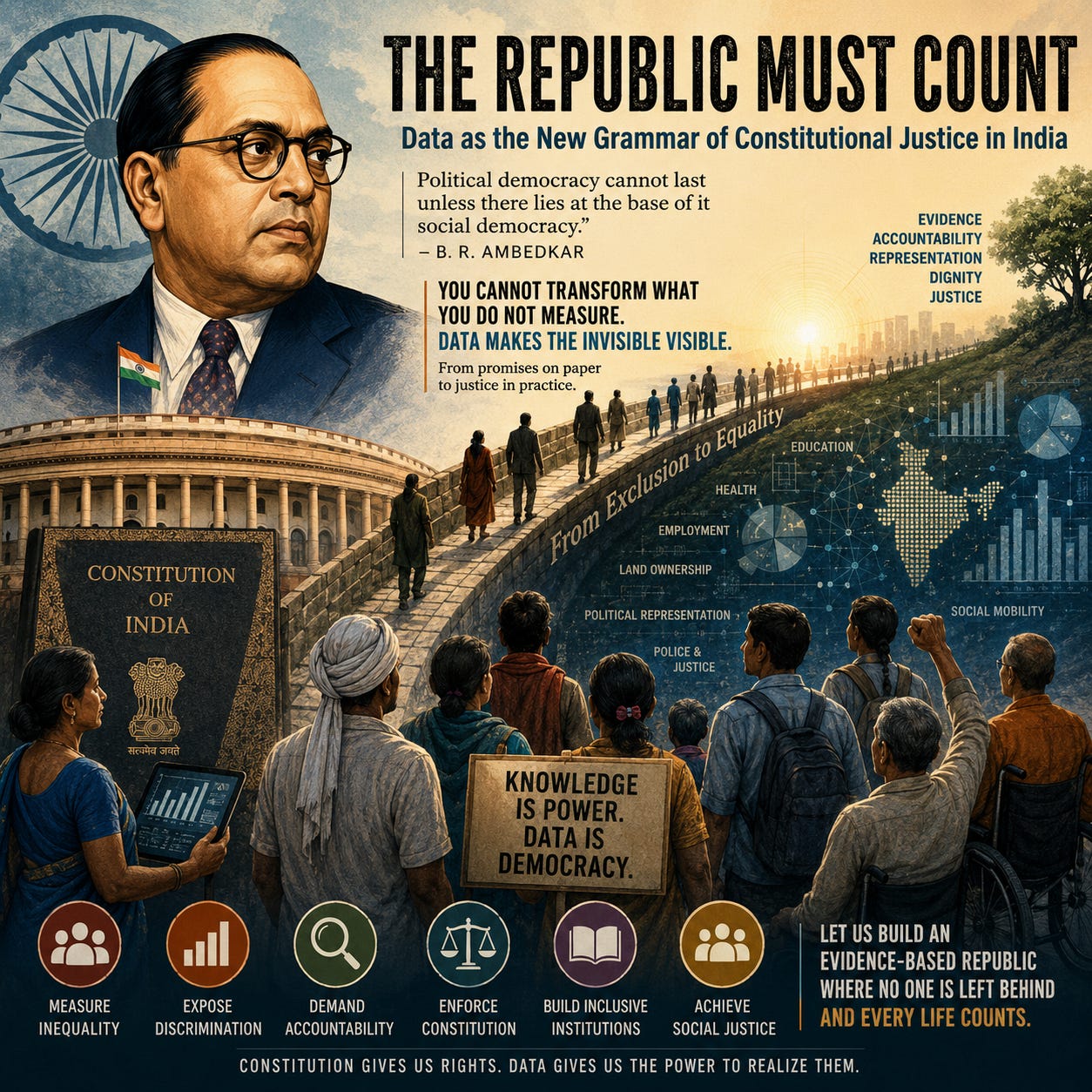
The history of democracy is often told as the history of constitutions, elections, courts, and political movements. These institutions undoubtedly matter, but they tell only part of the story. A democracy does not merely require the right to vote or the formal guarantee of equality before the law; it also requires the ability to know whether those promises are being fulfilled. Constitutional ideals remain aspirational unless citizens possess reliable evidence with which to evaluate the conduct of public institutions. In the twenty-first century, therefore, the struggle for justice increasingly depends not only on moral conviction or political mobilisation but also on the systematic production of public knowledge.
This insight lies at the heart of Chad Topaz’s Unlocking Justice. Drawing primarily upon the experience of the United States, Topaz demonstrates how statistical analysis has exposed patterns of racial discrimination in policing, sentencing, incarceration, and algorithmic decision-making that remained invisible when viewed through isolated cases. His larger argument, however, extends well beyond the American criminal justice system. It suggests that injustice rarely appears as a single dramatic event. Instead, it accumulates through thousands of seemingly ordinary administrative decisions whose collective effect becomes visible only when examined systematically. Data, in this sense, is not merely descriptive; it is democratic. It enables citizens to distinguish between anecdote and structure, between isolated error and institutional failure.
Few countries illustrate the importance of this insight more clearly than India. The Constitution of India is among the world’s most ambitious attempts to transform a deeply hierarchical society into a democratic republic founded upon liberty, equality, fraternity, and justice. Yet more than seven decades after independence, public debate frequently proceeds through assertions rather than evidence. Claims about merit, equality, reservation, development, representation, and discrimination are often advanced with great confidence but surprisingly little empirical scrutiny. The challenge before India is therefore not simply to defend constitutional values but to develop an empirical culture capable of measuring whether those values are being realised.
Dr. B. R. Ambedkar understood this necessity better than almost any political thinker of his generation. He is rightly celebrated as the principal architect of the Constitution, but he was equally remarkable for his insistence upon evidence. His writings on caste, education, labour, land ownership, political representation, and public finance were grounded in census reports, government statistics, committee proceedings, and comparative historical research. Long before the language of data science emerged, Ambedkar recognised that democratic reform depends upon accurate diagnosis. Sentiment alone cannot dismantle structures of inequality. Institutions must first be understood before they can be transformed.
This empirical orientation distinguished Ambedkar from many of his contemporaries. He refused to treat caste merely as a matter of religious doctrine or personal prejudice. Instead, he analysed it as a social system producing measurable consequences across every sphere of life. Educational exclusion, occupational segregation, unequal access to property, political under-representation, and economic deprivation were not isolated misfortunes but interconnected outcomes of an organised social order. His constitutional project therefore rested upon the conviction that justice requires not only legal principles but also continuous public examination of how those principles operate in practice.
This lesson remains profoundly relevant today. Much contemporary discussion assumes that caste has either disappeared or survives only in occasional acts of overt discrimination. Such assumptions misunderstand the nature of structural inequality. Institutions need not announce discriminatory intentions in order to reproduce unequal outcomes. Admission procedures, recruitment practices, credit allocation, public investment, healthcare access, housing markets, environmental burdens, and judicial processes may each appear formally neutral while nevertheless generating persistent disparities. Individual decisions can always be explained away as exceptional circumstances. Only when thousands of such decisions are examined together do enduring patterns become unmistakable.
For the Scheduled Castes, Scheduled Tribes, Other Backward Classes, Denotified and Nomadic Tribes, and many other historically marginalised communities, lived experience has long testified to these realities. Yet democratic politics requires more than experience alone. It requires publicly verifiable knowledge capable of persuading citizens beyond one’s own community. Data performs precisely this constitutional function. It transforms private suffering into public evidence and enables democratic institutions to confront inequalities that would otherwise remain obscured beneath anecdote and ideology.
This is particularly important because contemporary political discourse frequently substitutes rhetoric for measurement. Few ideas illustrate this tendency more clearly than the language of “merit.” Merit is often invoked as though it exists independently of history, social opportunity, educational infrastructure, nutrition, family resources, language, geography, or inherited wealth. Yet no serious social scientist would evaluate individual achievement without considering the unequal distribution of opportunities through which achievement becomes possible. If two children begin life under radically different conditions, identical examination scores cannot be interpreted as neutral indicators of ability. Opportunity itself becomes part of what is being measured.
Consequently, debates surrounding reservation cannot be reduced to abstract appeals either to equality or to merit. Reservation is fundamentally an evidence-based constitutional response to historically demonstrable inequalities. It rests upon the recognition that formal equality cannot eliminate disadvantages accumulated over centuries of exclusion. The constitutional question, therefore, is not whether reservation conforms to an abstract ideal but whether measurable inequalities continue to justify corrective intervention. This question cannot be answered through ideology alone. It requires continuous empirical investigation into educational access, public employment, institutional representation, income distribution, health outcomes, and social mobility.
Indeed, one of the most significant democratic reforms India could undertake would be the creation of a comprehensive constitutional data infrastructure. Every citizen should be able to examine reliable information regarding school admissions, university recruitment, faculty appointments, judicial diversity, police recruitment, access to healthcare, distribution of public expenditure, credit availability, land ownership, environmental exposure, and digital connectivity. Such information should be publicly accessible, independently audited, and presented in forms understandable to ordinary citizens. Transparency should become not merely an administrative virtue but a constitutional obligation.
The importance of such an infrastructure becomes even greater as artificial intelligence and algorithmic decision-making increasingly shape public administration. Governments and private institutions now employ automated systems in recruitment, welfare delivery, credit assessment, policing, and educational evaluation. These systems are frequently presented as objective because they rely upon computational methods rather than explicit human judgment. Yet algorithms learn from historical data. If that historical data reflects unequal social realities, algorithmic systems may simply reproduce existing inequalities with greater efficiency while concealing discrimination beneath the language of technological neutrality. Constitutional democracy must therefore insist that automated decision-making remain transparent, explainable, and open to independent scrutiny. Technology cannot be permitted to become an invisible mechanism for perpetuating historical injustice.
Universities have a particularly significant role to play in this transformation. Institutions of higher education should become constitutional observatories that systematically examine the functioning of democracy. Departments of law, economics, statistics, sociology, computer science, geography, public health, and public policy should collaborate in producing rigorous analyses of institutional performance. Students should learn not only constitutional doctrine but also the empirical methods necessary to evaluate whether constitutional promises are being fulfilled. Such an intellectual culture would strengthen both scholarship and citizenship by encouraging evidence-based public debate rather than ideological polarisation.
This approach would also reshape democratic movements themselves. Historically, movements for social justice have relied upon moral argument, political organisation, and public protest. These instruments remain indispensable. Yet the digital age offers additional possibilities. Right to Information applications, open government databases, satellite imagery, geospatial analysis, public dashboards, and citizen-generated datasets allow communities to document patterns of exclusion with unprecedented precision. Journalists, lawyers, researchers, activists, and ordinary citizens can increasingly collaborate in producing independent public knowledge capable of challenging official narratives. Democratic accountability becomes stronger when institutions know that their decisions are not merely contested but carefully measured.
Nevertheless, the expansion of data must never come at the expense of human dignity. Measurement itself possesses ethical dangers. States may collect excessive information, invade privacy, or employ surveillance technologies in ways that undermine civil liberties. Citizens must therefore distinguish between democratic measurement and authoritarian monitoring. The purpose of constitutional data is not to classify populations for purposes of control but to ensure that public institutions remain accountable to constitutional principles. Privacy, transparency, informed consent, independent oversight, and legal safeguards must accompany every expansion of data collection. Justice requires evidence, but it also requires limits upon the power of those who gather that evidence.
Ultimately, the significance of data lies not in numbers themselves but in the democratic habits they encourage. A republic committed to equality should continuously ask whether its institutions are reducing or reproducing historical disadvantage. Policies should be treated as hypotheses subject to evaluation rather than ideological commitments immune from evidence. If educational inequality declines, citizens should know why. If disparities persist, governments should explain what corrective measures will follow. Constitutional governance becomes a process of collective learning in which institutions remain open to revision because they remain answerable to facts.
Ambedkar repeatedly warned that political democracy cannot survive unless supported by social democracy. In the twenty-first century, one may extend his insight further. Social democracy cannot flourish unless supported by epistemic democracy—the equal capacity of citizens to know how institutions actually function. Without reliable public knowledge, constitutional rights become vulnerable to misinformation, prejudice, and manufactured narratives. With reliable evidence, however, democratic debate acquires greater intellectual honesty because competing claims must confront observable reality.
India’s constitutional revolution remains unfinished. The task before the present generation is not simply to preserve constitutional ideals but to develop the institutional capacities through which those ideals can be measured, criticised, and improved. For the Scheduled Castes, Scheduled Tribes, Other Backward Classes, and all communities historically denied equal participation, data should not be viewed merely as a technical resource or administrative convenience. Properly governed, it becomes a democratic instrument that transforms invisible patterns into public knowledge and converts constitutional promises into measurable responsibilities.
The future of justice, therefore, will depend not only upon what the Constitution says but also upon what the Republic is willing to count. A democracy that measures inequality honestly is better equipped to reduce it. A democracy that refuses measurement risks allowing inherited privilege to masquerade as natural order. The Constitution gave India the language of equality. The next great democratic task is to build an equally powerful language of evidence, so that justice may be evaluated not through comforting myths or political slogans but through the lived realities of every citizen. Only then can the Republic move closer to fulfilling Ambedkar’s enduring vision of liberty, equality, and fraternity as concrete conditions of everyday life rather than merely inspiring constitutional ideals.